This cat was drawn during the war. Exhibition
Mar 01, 26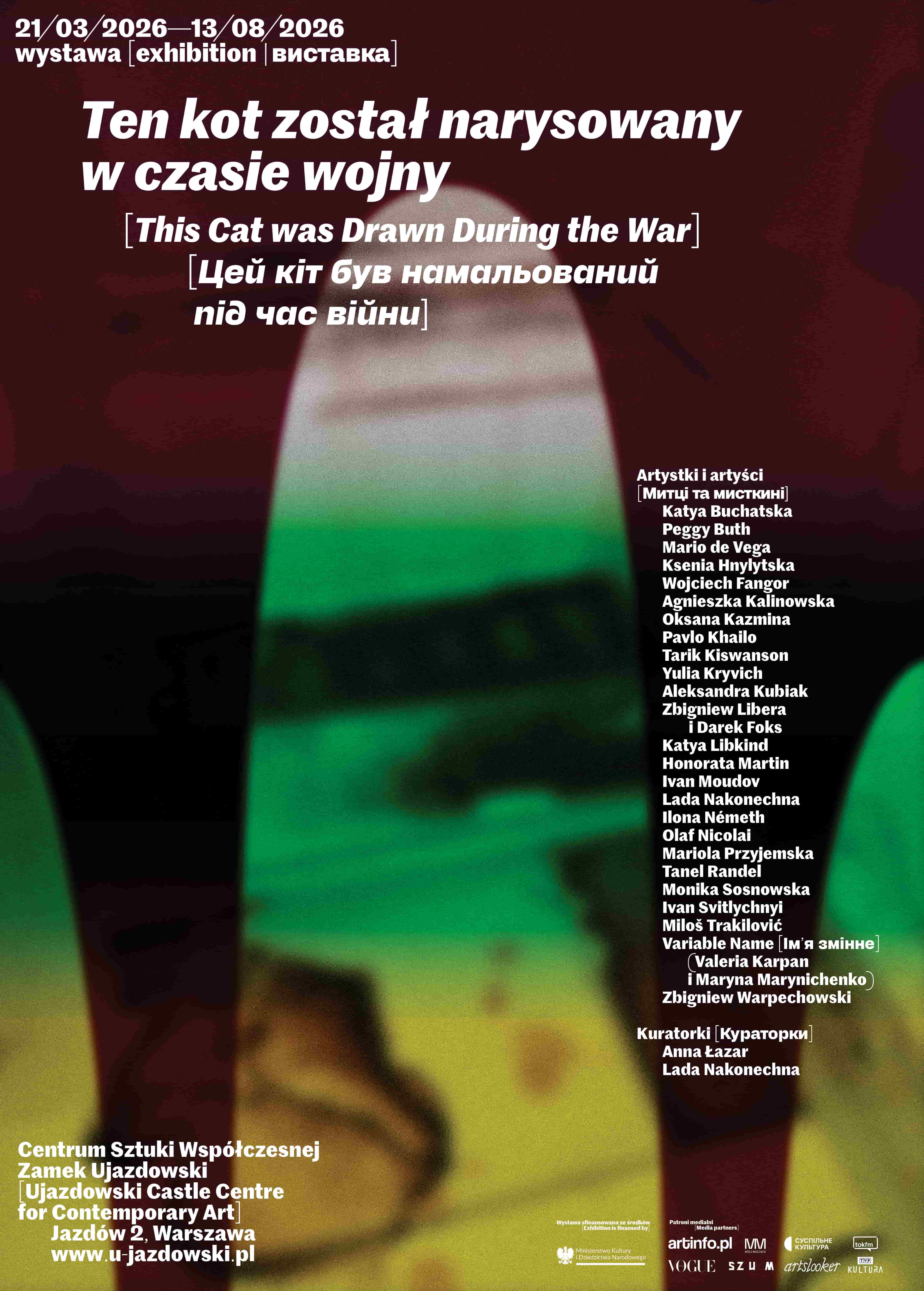
20th March 2026 – 13th September 2026
The Ujazdowski Castle Centre for Contemporary Art
Opening: 20th March 2026, 7 PM, free entrance
Curators
Anna Łazar and Lada Nakonechna
Artists
Katya Buchatska (Ukraine), Peggy Buth (Germany), Mario de Vega (Mexico), Wojciech Fangor (Poland), Ksenia Hnylytska (Ukraine), Agnieszka Kalinowska (Poland), Oksana Kazmina (Ukraine), Pavlo Khailo (Ukraine), Tarik Kiswanson (France/Palestine), Yulia Kryvich (Poland/Ukraine), Aleksandra Kubiak (Poland), Zbigniew Libera and Darek Foks (Poland), Katya Libkind (Ukraine), Honorata Martin (Poland), Ivan Moudov (Bulgaria), Lada Nakonechna (Ukraine), Ilona Németh (Slovakia), Olaf Nicolai (Germany), Mariola Przyjemska (Poland), Tanel Randel (Estonia), Monika Sosnowska (Poland), Ivan Svitlychnyi (Ukraine), Miloš Trakilović (Bosnia and Herzegovina/the Netherlands), Variable Name/Назва змінна (Valeria Karpan and Maryna Marynichenko) (Ukraine), Zbigniew Warpechowski (Poland).
The power of art — as opposed to propaganda — lies, among other things, in its ability to unsettle our habitual ways of perceiving reality and to reveal doubts. It is precisely within the field of contemporary art that meanings important to the community are negotiated. When looking at an artwork, it is worth asking questions both about its message and the means employed, as well as about the sources from which its formal solutions derive. By interpreting and provoking reality, artists expose the dominant discourses of visual politics.
Does war change art? Yes, just as it changes human life. Most existing problems intensify, and new ones arise.
The exhibition title This Cat Was Painted During the War only appears to be a simple statement. First of all, this is not a cat (“ceci n’est pas une pipe” — “this is not a pipe”), although it evokes associations with the dopamine-driven pleasure of looking at pictures on the internet. The sentence was spoken by the artist Kateryna Libkind, emphasising that war provides an inescapable frame for every situation.
Secondly, the verb “painted” plays with the widespread belief that art is created by drawing, painting or, alternatively, sculpting. Meanwhile, the exhibition presents works created using other strategies.
Thirdly, we are confronted with a fundamental question about the direction of our own actions in times of total crisis. Is there still room for critical reflection during wartime?
Thus, the exhibition addresses art created in the face of war. Issues related to the long-lasting imagery of the Second World War and the war in the former Yugoslavia return, and above all the war closest to us in time and geography — the war against Ukraine, whose struggle for freedom and life we support. It is from the experience of this war that our exhibition grows.
The presented works were selected in response to questions we asked ourselves as curators. Is art effective? What can we expect from it in times of crisis? How does it address important issues in public debate, including the experience of war, European identity, women’s rights, or decolonisation from the perspective of countries of the former socialist bloc? How does war affect our sensitivity when documentation from sites of crimes coexists on computer screens with pop culture and AI-generated images? And can art help us imagine the world differently from the ways suggested by dominant narratives?
Public Program
Curator
Kateryna Iakovlenko
The public programme brings together panel discussions and conversations that reflect on wars as an ongoing condition shaping Europe’s cultural, political and personal landscape. Since experiences differ, what do we have in common and what connects us today?
Moving beyond linear historical narratives, the programme examines how the legacy of the Second World War, socialism, post-socialist transformations and ongoing conflicts continues to shape memory, everyday experience and artistic practices, and how all these experiences influence our present. Art, culture and literature are viewed here as critical tools that reveal recurring historical crises and may warn against new tragedies.
The programme focuses on testimony, evidence and the ethics of representation, while also exposing the fragile boundary between testimony of violence offered by societies entangled in conflict and the exploitation of such testimony by societies that impose violence and generate war.
This series of conversations highlights the importance of the individual while firmly proposing collective solutions such as solidarity, care and various forms of support.
21 March, 12:30
Europe after 1945: Art, Memory and Historical Continuities
The panel is devoted to post-1945 Europe, understood not as a closed chapter of history but as a space of unresolved traumas and uneven memories manifested through art. Bringing together perspectives from the Baltic region and Central and Eastern Europe, the discussion explores how different historical experiences — the Second World War, socialism, post-socialist transformations and contemporary wars — shape a fragmented yet interconnected European memory landscape. And if the post-war period is still ongoing, where does the war actually end, and what role does art play in these processes: can it protect, preserve memory or warn against future crises?
Participants:
Valentinas Klimašauskas — curator, writer and Director of the Contemporary Art Centre in Vilnius since January 2025.
Tomáš Pospiszyl — art historian, educator, writer and curator based in Prague. Since 2016 he has headed the Department of Theory and History of Art at the Academy of Fine Arts in Prague.
Zdenka Badovinac — curator and art critic, Director of Moderna Galerija (Museum of Modern Art) in Ljubljana since 1993.
Edit András — art historian, critic and curator working in Budapest and on Long Island.
Moderator:
Kateryna Iakovlenko — curator, visual culture researcher and writer from Ukraine.
22 March, 12:30
Why Do Justice and Testimony Require Evidence? Culture as Resistance and the Problem of Appropriation
The discussion addresses the political instrumentalisation of culture and the growing demand for evidence, verification and confirmation in contexts of war, violence and systemic injustice. The panel considers art, journalism and cultural practices as forms of testimony, especially where legal and political mechanisms fail or remain ineffective.
Participants:
Anastasiia Cherednichenko — Chair of the Ukrainian ICOM Committee.
Damir Šagolj — co-founder of WARM and current Director of the WARM organisation in Sarajevo.
Johana Kotišová — Associate Professor of Documentary Studies and Journalism at the University of Amsterdam.
22 March, 16:00
Personal Dimensions of War
The conversation focuses on war through personal and embodied experience. Drawing on literature, historical research and material culture, participants reflect on the loss of home, language and established ways of life, as well as on the fragile structures of everyday survival.
Participants:
Anna Gruver — writer from Donetsk, author of the novel Immovable Property (Donetsk / Kraków).
Karolina Sulej — doctoral researcher at the Institute of Polish Culture, University of Warsaw, where she works in the Holocaust Memory Research Group; fashion history expert, author and co-author of several books, including Personal Effects: Stories of Clothing in Concentration Camps and Death Camps.
Moderator:
Kateryna Iakovlenko — curator, visual culture researcher and writer from Ukraine.